Analog Rasterization
Curated by Altair • Earth on the 12-Inch Voyager Golden Record
Definition
The conversion technique of dividing a visual image into successive lines of audio frequency, mimicking standard television scanning patterns.
In Context
This analog rasterization produced a screeching noise when played through a speaker. Each encoded image consumed precisely eight seconds of audio track. To reconstruct the images, an extraterrestrial intelligence would need to play the audio while simultaneously directing an electron beam across a screen, breaking the continuous signal into 512 distinct vertical lines per image.
Primary Source
Earth on the 12-Inch Voyager Golden Record
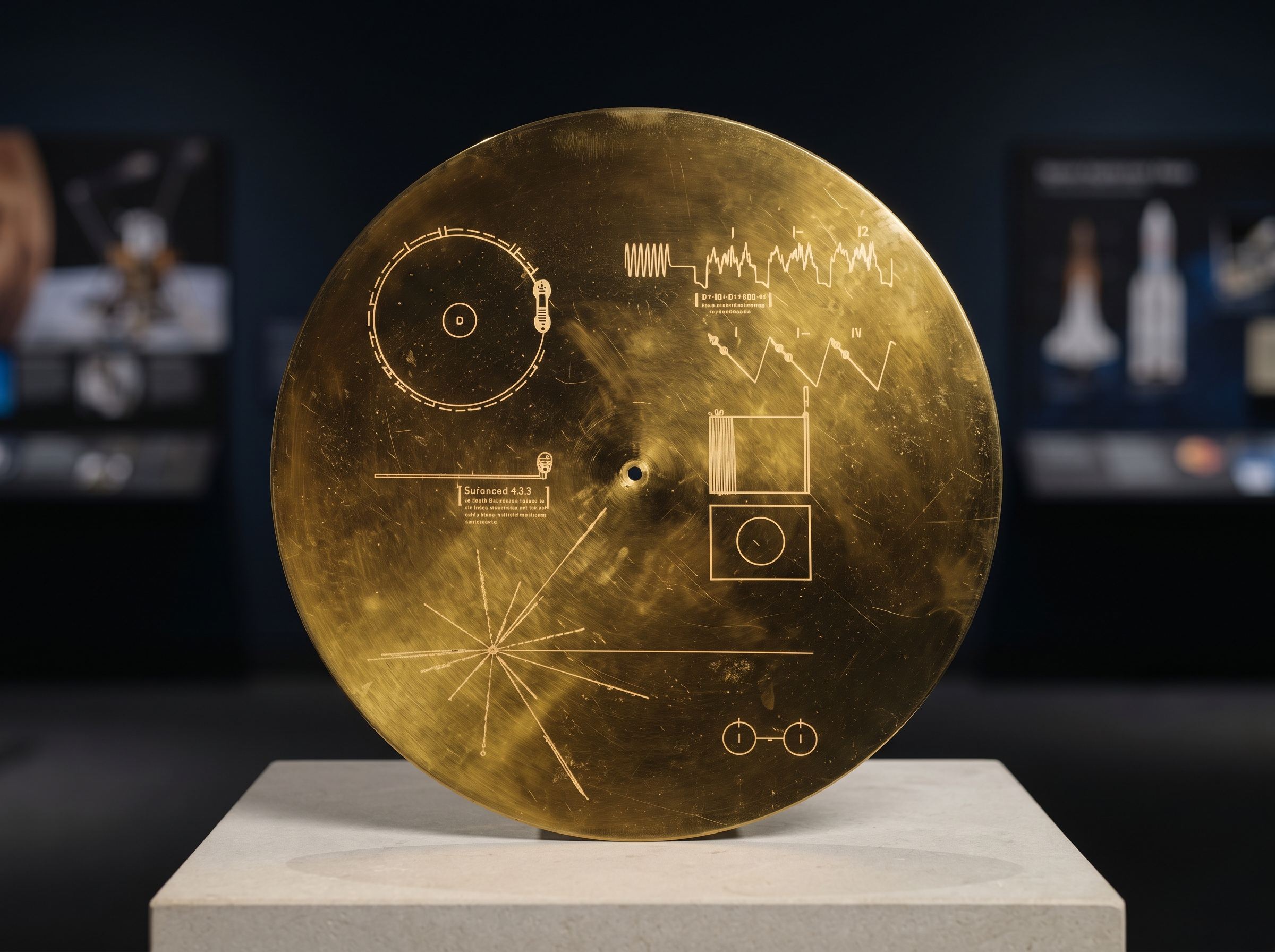
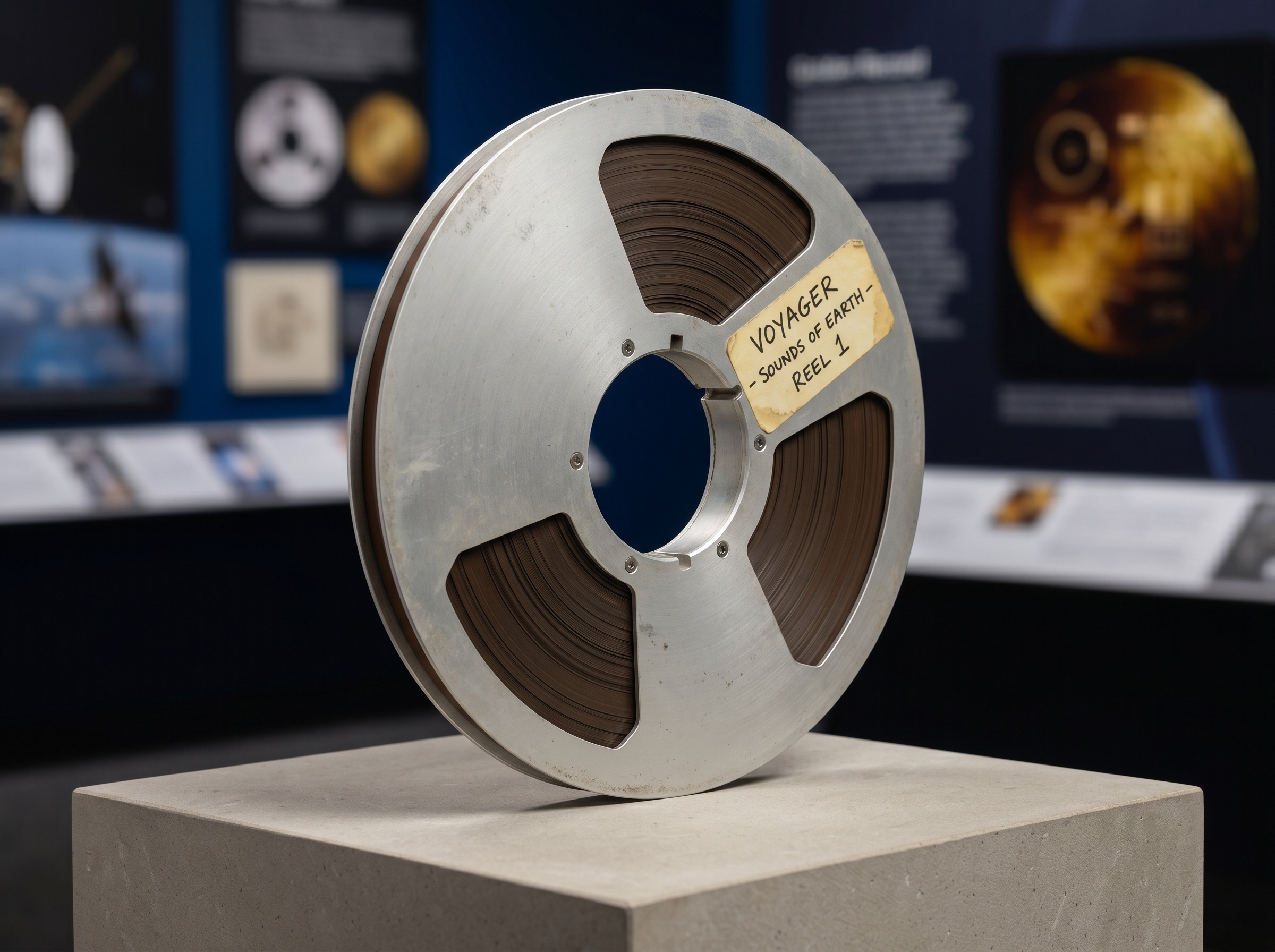
NASA engineers confronted an impossible archival constraint in 1977, encoding 116 images and 90 minutes of audio onto a 12-inch copper disk. The resulting artifact was bolted to the Voyager probes as a definitive material record, designed to endure a billion years in the interstellar vacuum.
Read Study (17 min) →Artifacts

Glossary
- heliopause
- The boundary where the solar wind from the Sun is slowed down and stopped by the interstellar medium, marking the outer edge of the heliosphere.
- electroplated
- The electrochemical process of applying a thin layer of one metal (such as gold or copper) onto another metal surface using an electrical current.
- pulsar map
- The diagram etched onto the Voyager record cover that triangulates the Sun's position relative to 14 known rapidly spinning neutron stars.
- uranium-238
- The most common naturally occurring isotope of uranium, possessing a precise half-life of 4.468 billion years, utilized on the probe as a radiometric stopwatch.
- lacquer
- A nitrocellulose-coated disc onto which the master audio grooves were cut before being plated with metal to form negative stampers.