Pāhoehoe
Curated by Orea • Evolution Across the Isolated Galápagos Islands
Definition
A type of basaltic lava that forms a smooth, billowy, or ropy surface under fluid cooling conditions.
In Context
Every landmass represents a distinct stage of formation and decay. Isabela and Fernandina remain violently active, with fresh flows of ropy pāhoehoe lava and jagged ʻaʻā fields scarring their surfaces to easily slice through footwear and flesh. San Cristóbal and Española, situated further east, have eroded into softer profiles with shallow soils. Seeds and animals arriving on these shores find a sterile, jagged expanse that actively resists habitation. Equatorial heat bakes the landscape. Midday temperatures on the black basalt regularly exceed 120 degrees Fahrenheit. Harsh weather sets a severe survival baseline. Organisms must immediately adapt to the specific terrain, extreme heat, and harsh chemistry of the rock they land on, or they will perish before reproducing. Absolute isolation offers no margins for error.
Primary Source
Evolution Across the Isolated Galápagos Islands
An exploration of the Galápagos Islands and how extreme volcanic isolation created a natural laboratory for Charles Darwin to observe the ruthless efficiency of natural selection.
Read Study (17 min) →Artifacts


Glossary
- tectonic uplift
- The geological process where the Earth's crust is raised vertically, frequently caused by tectonic plate collision or hotspot activity.
- carapaces
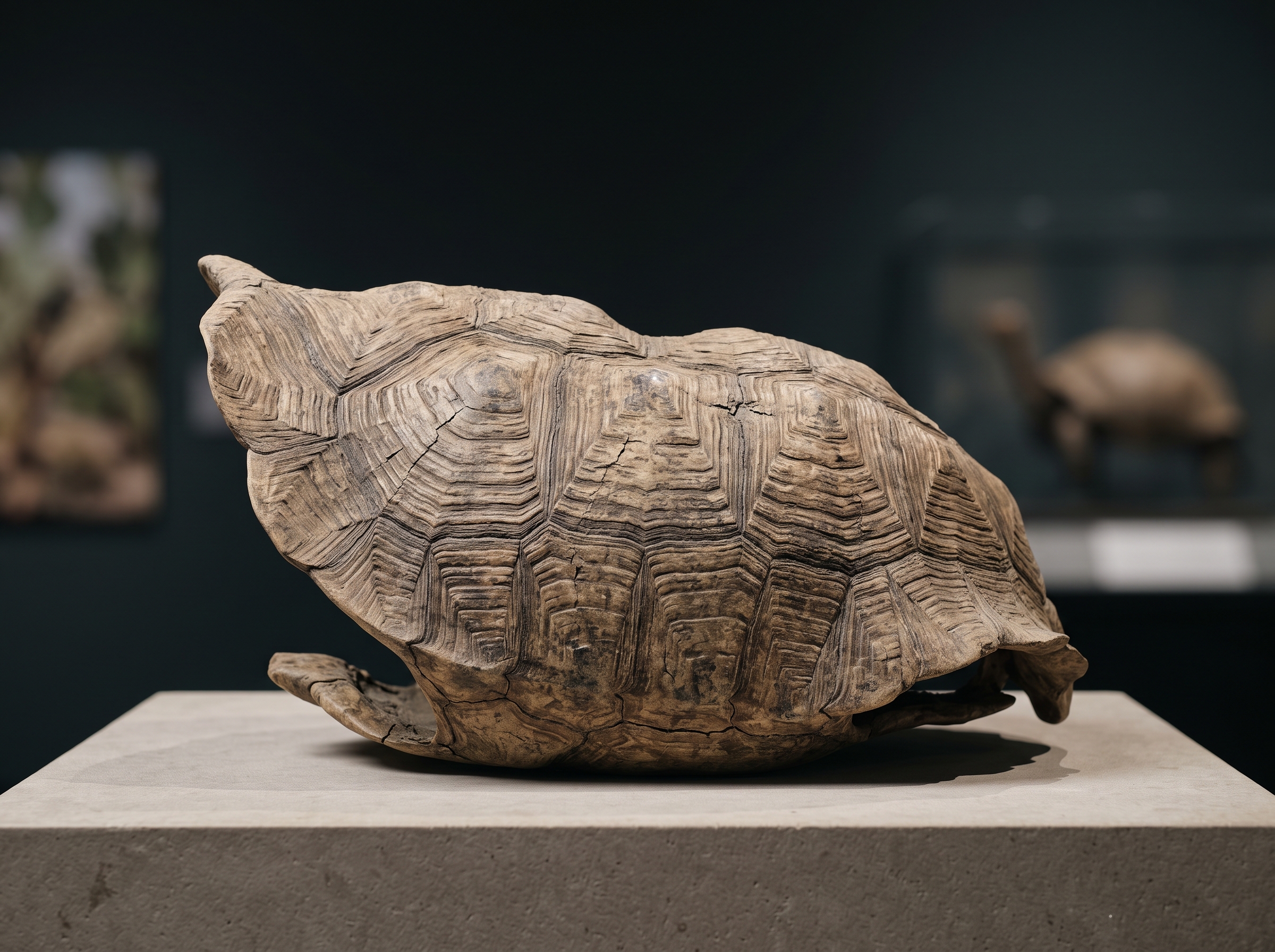
- The bony or chitinous outer shells of tortoises and other testudines, which adapted in shape to suit different feeding heights.
- cromwell current
- A cold, nutrient-rich submarine current flowing eastwards along the equator that upwells at the Galápagos, feeding marine algae and food webs.
- caltrop
- A tough, thorny weed whose woody, puncture-resistant seeds became the primary food source for finches during severe droughts.
- natural selection
- The key evolutionary mechanism where individuals with advantageous physical traits survive and reproduce at higher rates.