Varennes, the Guillotine and the French Revolution
Near midnight on June 20, 1791, Swedish officer Count Axel von Fersen guided a custom-built green-and-yellow coach onto the eastern road from Paris toward the border fortress of Montmédy. Inside rode King Louis XVI, dressed in the plain brown coat of a valet named Durand, alongside Queen Marie Antoinette and their two children. Since the fall of the Bastille two years earlier, deputies in the National Assembly had tried to preserve a constitutional monarchy by maintaining the legal fiction that their king accepted parliamentary limits. By leaving a handwritten declaration on his Tuileries desk repudiating every decree signed since October 1789, Louis shattered that compromise himself. Once a monarch turns fugitive, moderate reform gives way to a struggle for survival.
Historical Chronology
- 1791: Louis XVI and Marie Antoinette flee Paris in a heavy berline coach on June 20 and are arrested at Varennes after postmaster Jean-Baptiste Drouet recognizes the king.
- 1792: Armed Parisian sections and fédérés storm the Tuileries Palace on August 10, slaughtering the Swiss Guard and imprisoning the royal family in the Temple fortress.
- 1792: Locksmith François Gamain reveals the hidden Tuileries iron wall safe on November 20, exposing the king's secret correspondence with foreign courts and sealing his indictment.
- 1793: Following the roll-call death vote in the National Convention, Citizen Louis Capet is guillotined on January 21 at the Place de la Révolution.
- 1793: After the failed Carnation Plot in the Conciergerie prison, the Revolutionary Tribunal convicts and executes Queen Marie Antoinette on October 16.
- 1794: The Committee of Public Safety silences and executes Georges Danton on April 5 before passing the Law of 22 Prairial, eliminating defense counsel and witnesses.
- 1794: Terrified deputies overthrow Maximilien Robespierre on 9 Thermidor (July 27); with his jaw shattered by a pistol ball, he is guillotined the following afternoon.
Surviving Artifacts & Material Evidence
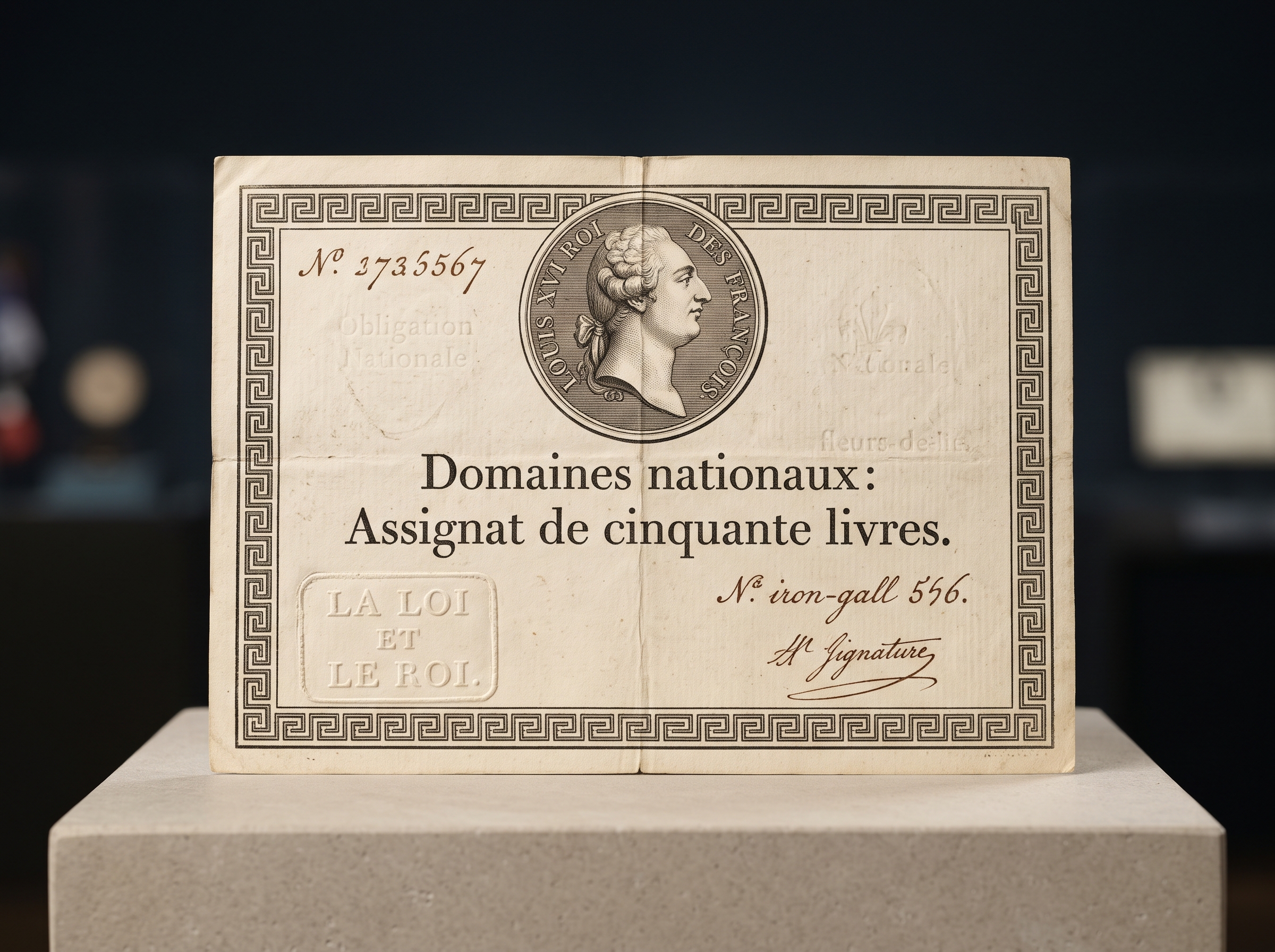
50-Livre Assignat Banknote
A 1790 French revolutionary paper promissory note bearing the engraved profile medallion of Louis XVI, the exact currency series used to identify the disguised king during the Flight to Varennes.
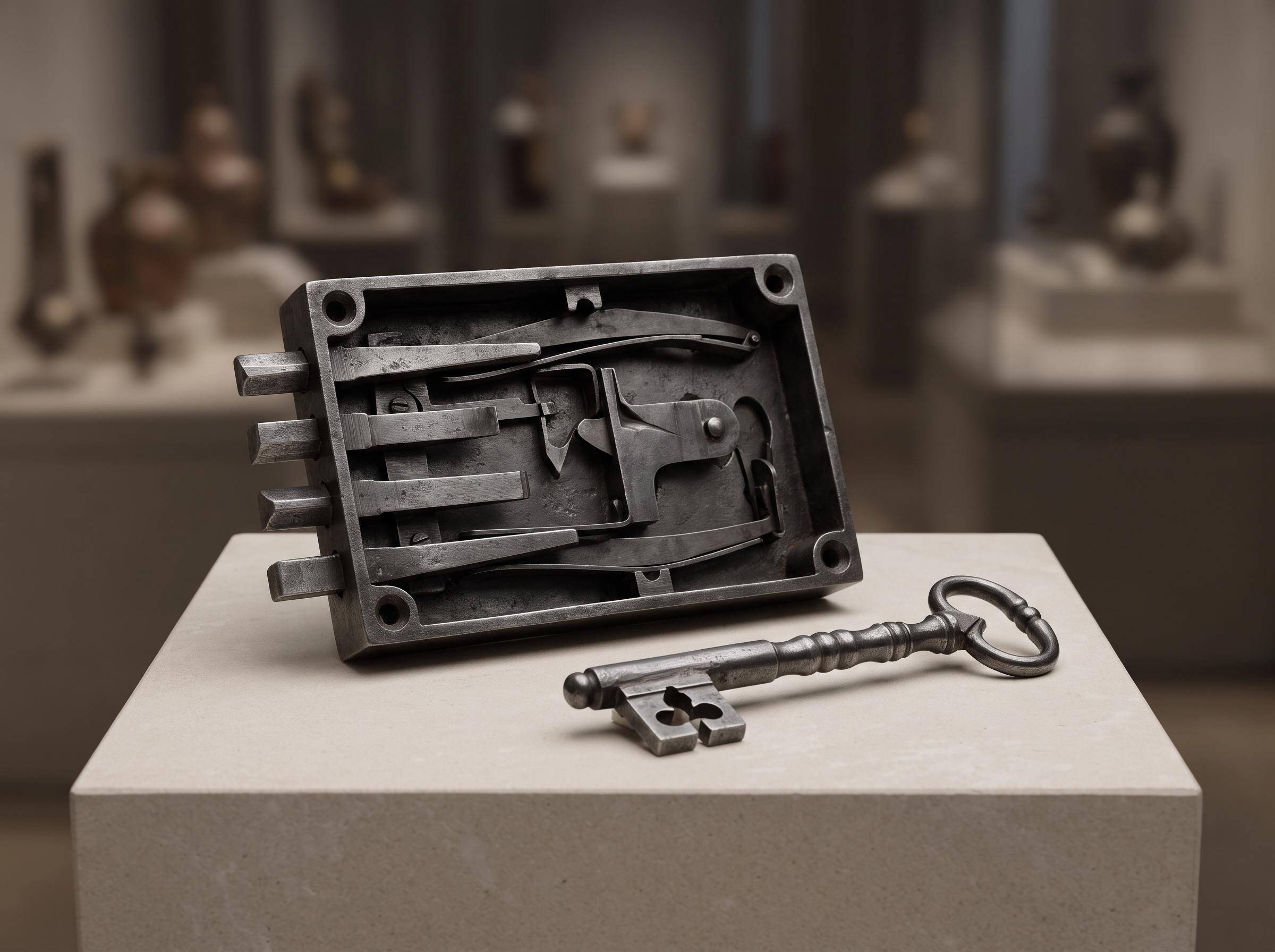
Tuileries Iron Chest Key
Hand-forged wrought-iron warded key and secret wall-safe lock mechanism crafted by royal locksmith François Gamain for Louis XVI's hidden compartment in the Tuileries Palace.
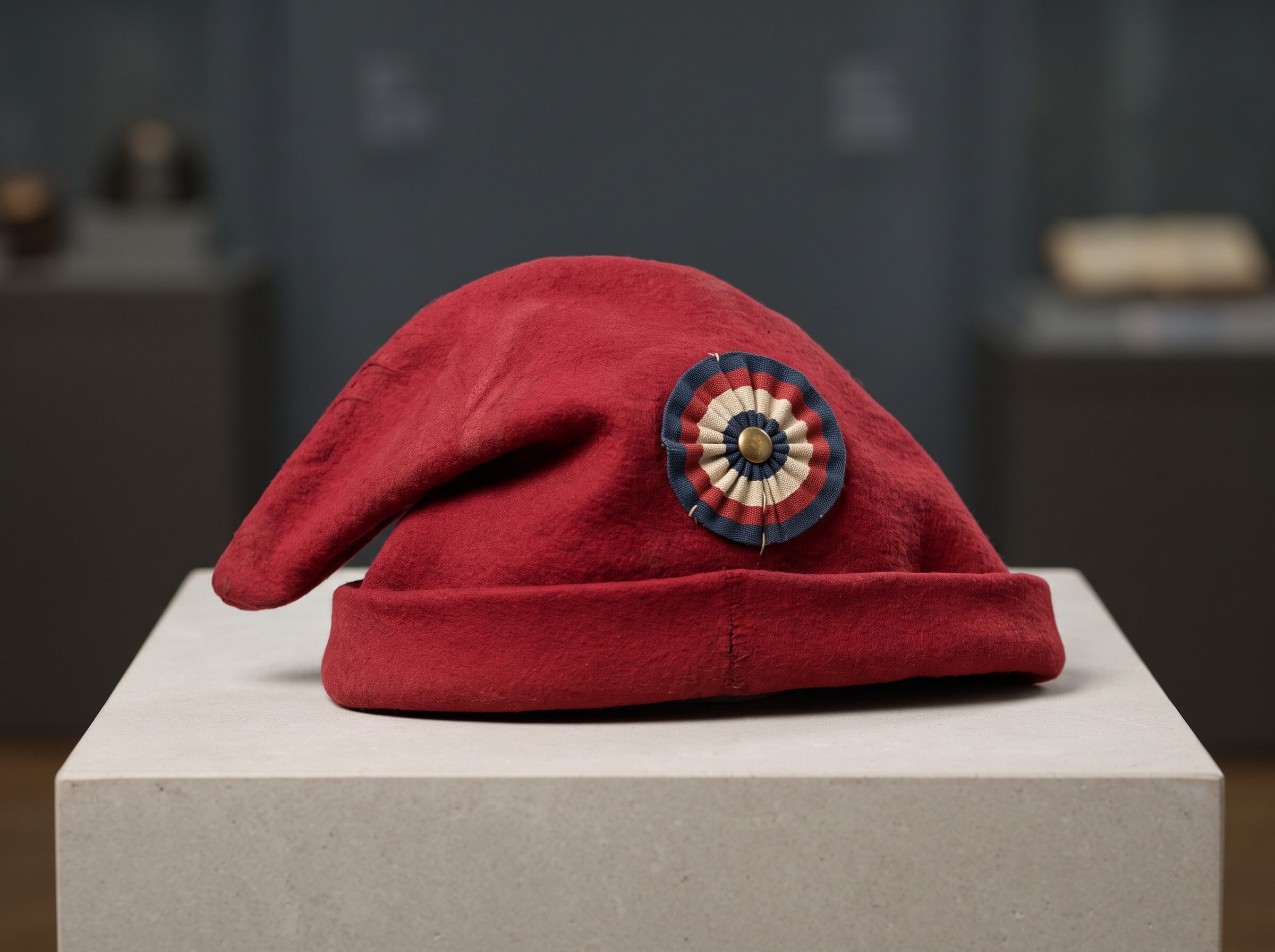
Phrygian Liberty Cap
Madder-red fulled wool bonnet rouge sewn with a hand-pleated blue, white, and red wool-and-linen Tricolor cockade, worn by Parisian sans-culottes and revolutionary magistrates.
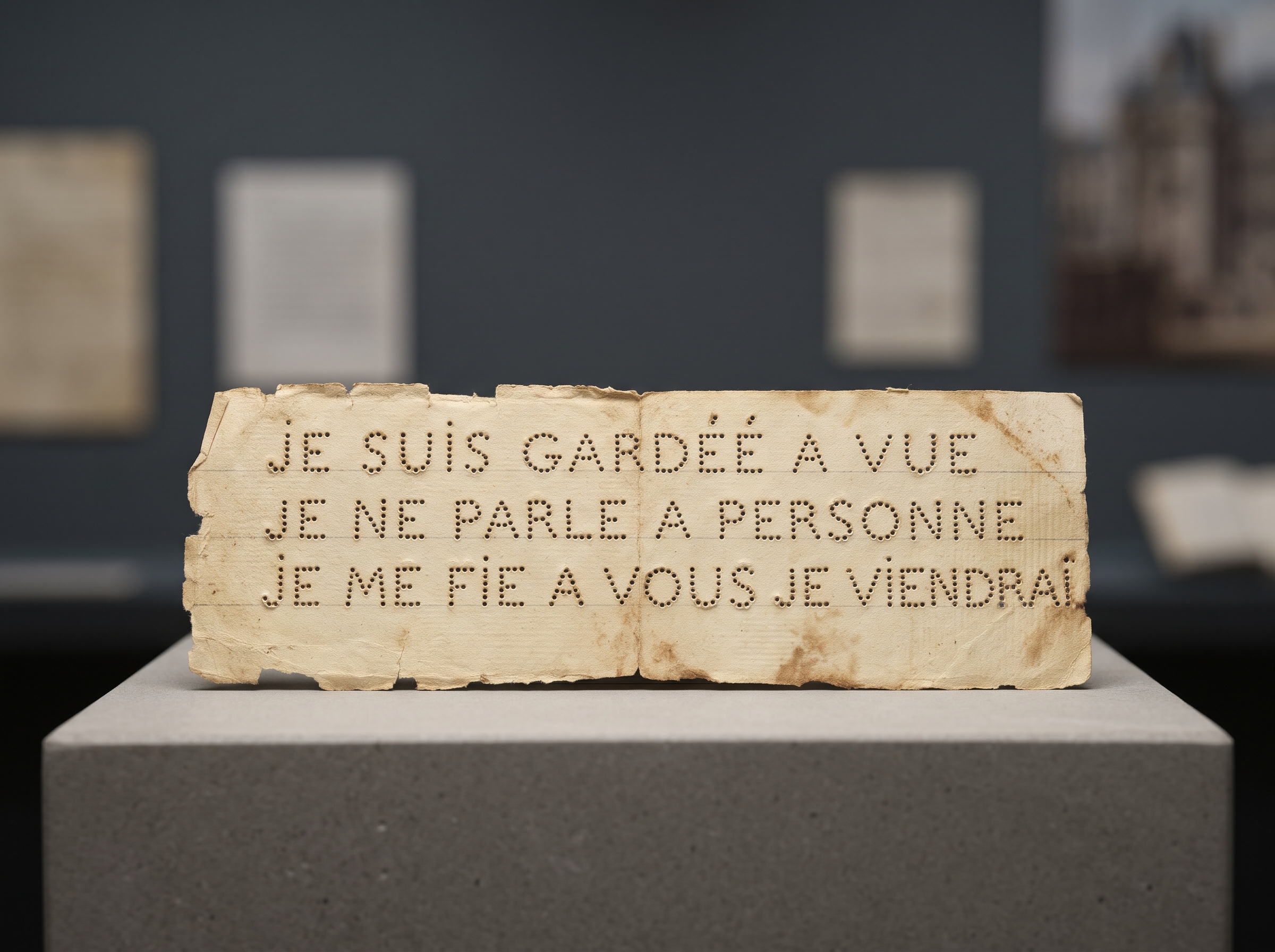
Pin-Pricked Conciergerie Note
Clandestine paper strip pierced with a sewing pin by Queen Marie Antoinette inside the Conciergerie prison during the August 1793 Carnation Plot, preserved at the Archives Nationales.
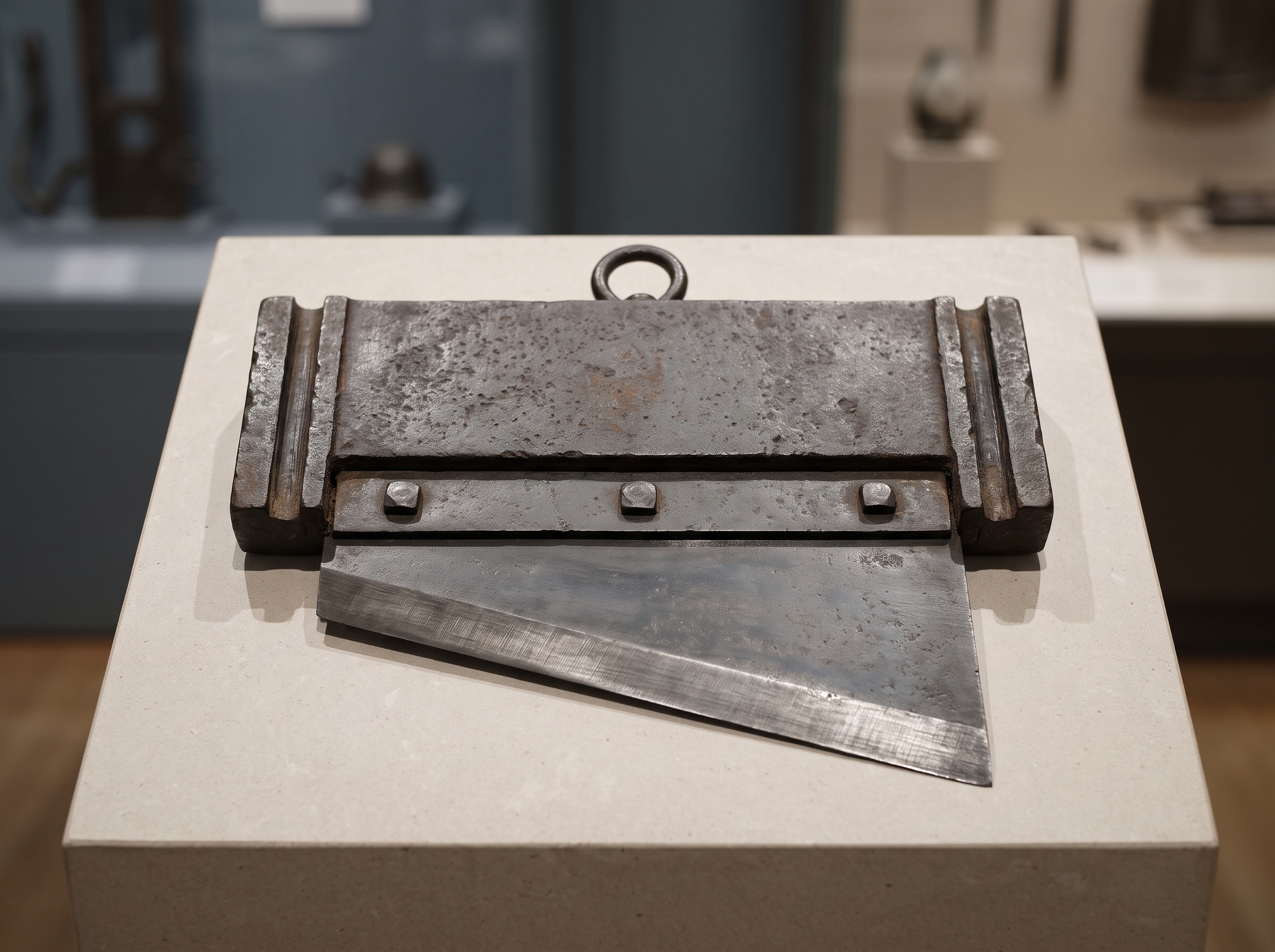
Oblique Steel Guillotine Blade
Weighted 1792-pattern forged steel couperet blade engineered by Tobias Schmidt with a 45-degree diagonal cutting edge bolted to a heavy cast-iron mouton.
Six fresh post-horses strained in their leather harnesses out of the relay station at Bondy in the early hours of June 21, 1791, pulling a heavily laden berline along the high road toward Châlons. Ordered the previous December in the name of Baroness de Korff and completed in March by Parisian coachbuilder Jean-Louis, the coach had been paid for by Count Axel von Fersen, a Swedish aristocrat devoted to Queen Marie Antoinette, for a sum variously recorded between 3,944 and 5,944 livres. A lighter two-carriage plan had been considered, but the royal family insisted on staying together. To accommodate six passengers under one roof, the green-and-yellow carriage carried padded velvet seats and varnished-leather night vessels alongside a portable larder stocked with cold veal and champagne.
Weight and mistimed connections slowed the escape from the first league. Armed with a passport issued in the name of Baroness de Korff, a real Swedish-born widow of a Russian officer, and signed by Foreign Minister Armand Marc de Montmorin, the royal party had slipped out of the Tuileries Palace in stages the previous night through an unguarded ground-floor doorway into the Cour des Princes. Delays during the staggered palace exit pushed departure past midnight, while snapped harness traces near Chaintrix cost further time along the road. By the time the coach rolled into the relay station at Pont-de-Somme-Vesle that afternoon, the royalist hussars stationed there by General François Claude Amour, Marquis de Bouillé, had already withdrawn into the countryside after waiting in vain and alarming local peasants.
Lantern Light on a 50-Livre Note
At roughly 7:30 on the evening of June 21, the dusty carriage halted before the post-house at Sainte-Menehould to change horses. Inside the coach, Louis XVI leaned near the lowered window while fresh mounts were hitched to the swingletrees. Local postmaster Jean-Baptiste Drouet, a former dragoon who had attended the Festival of the Federation in Paris the previous summer, noticed the unusual deference shown by the yellow-jacketed bodyguards perched on the exterior box to the stout man dressed as Baroness de Korff's valet.
According to Drouet's subsequent testimony before the National Assembly, he compared the passenger's features against a printed 50-livre assignat. Issued by the National Assembly and backed by confiscated Church lands, the paper promissory note carried an engraved copperplate medallion profile of the king near its upper margin. Convinced that the heavy jawline and aquiline nose on the banknote matched the man waiting in the courtyard, Drouet refrained from attempting an arrest in a square where royalist cavalrymen were drinking at the local tavern. Instead, he waited for the coach to depart toward Clermont, saddled two fast horses with municipal clerk Jean-Chrisostome Guillaume, and galloped through the wooded tracks of the Argonne ridge to intercept the party at Varennes-en-Argonne.
Around 11 o'clock that night, the royal carriage entered the steep, narrow streets of Varennes while its bodyguards searched in the dark for a relay team stationed on the far side of the Aire River. Drouet had arrived minutes earlier through a side lane. Racing past the halted coach to the tavern of the Bras d'Or, the postmaster roused local youths and National Guardsmen, who dragged a heavy furniture wagon across the narrow stone bridge over the Aire. When the carriage reached the vaulted archway of Saint-Gengoult above the bridge, town procurator Jean-Baptiste Sauce, a tallow chandler and grocer, stepped into the roadway with a lantern and demanded the travelers' passports.
Forced to climb a narrow wooden staircase into two small rooms above Sauce's grocery shop, Louis XVI maintained his disguise for several hours until Jacques Destez, a local magistrate who had seen the king at Versailles, recognized him and knelt on the floorboards. Louis dropped the pretense and embraced Sauce, claiming he only wished to travel to Montmédy, 30 miles away, to negotiate freely with the provinces away from Parisian daggers. Outside, church bells rang the tocsin across the Meuse valley. By dawn, thousands of peasants armed with scythes and muskets packed the streets of Varennes, sealing off the town before Bouillé's loyalist regiments could cross the river. On June 25, the royal coach rolled back into Paris through silent crowds of hundreds of thousands who kept their hats on their heads while National Guardsmen marched alongside holding their muskets upside down as at a military funeral.
Pikes at the Tuileries and the Iron Safe
Moderate deputies led by Antoine Barnave and Gilbert du Motier, Marquis de Lafayette, attempted to salvage the Constitution of 1791 by issuing an official parliamentary report claiming that counter-revolutionaries had abducted the king. Few Parisians believed the lie. When petitioners gathered at the Champ de Mars on July 17, 1791, to sign a Cordelier Club manifesto demanding the king's deposition, Lafayette's National Guard opened fire into the crowd, killing between 12 and 50 unarmed citizens. Constitutional reform had lost its moral authority before the new charter even took effect that September.
War with Austria and Prussia in the spring of 1792 exposed the double game played inside the Tuileries. While French volunteer battalions retreated in disorder along the northern frontier, Louis XVI used his constitutional veto to block decrees deporting non-juring priests and assembling 20,000 provincial fédérés outside Paris. Meanwhile, Marie Antoinette secretly transmitted French campaign plans to Austrian diplomat Count Florimond de Mercy-Argenteau using ciphered dispatches. On July 25, 1792, Charles William Ferdinand, Duke of Brunswick and commander of the allied Austro-Prussian army, issued a proclamation threatening Paris with "an exemplary and eternally memorable vengeance" and total military execution if the royal family suffered the slightest insult.
Published in Parisian newspapers on August 3, the Brunswick Manifesto achieved the exact opposite of its intent. Convinced that the king was coordinating the foreign invasion from inside the capital, 47 of the 48 Parisian street sections demanded his immediate dethronement. Before dawn on August 10, 1792, an insurrectionary Commune backed by Cordelier leader Georges Danton seized the Hôtel de Ville and rang the city's church bells. Columns of working-class sans-culottes, named for the long striped wool trousers they wore in place of aristocratic silk knee-breeches, marched on the Tuileries Palace alongside Marseillais and Breton volunteer battalions pulling brass cannon.
Moments before the fighting began, Louis XVI abandoned his defenders and walked across the gardens with his family to seek shelter inside the riding school of the Legislative Assembly. Left without clear orders inside the palace courtyards, 900 red-coated Swiss Guards exchanged close-range musket volleys with the insurgents until the king sent a written note ordering his troops to cease fire and retire to their barracks. As the Swiss fell back across the gardens, insurgents overwhelmed and slaughtered roughly 600 of them with pikes and sabers, losing nearly 400 of their own fighters in the assault. Stripped of his crown, Louis was transferred three days later to the medieval Temple fortress, where his family was later confined inside its 50-meter-high stone keep with walls nine feet thick.
Even after the monarchy was formally abolished on September 21, 1792, moderate Girondin deputies in the newly elected National Convention hoped to delay a regicide trial. That effort collapsed on November 20, 1792. Locksmith François Gamain, who had spent years forging intricate warded locks alongside the king at Versailles, visited Interior Minister Jean-Marie Roland and revealed that in May 1792 he had helped Louis cut a secret cavity into the stone wall of an interior passage at the Tuileries, concealed behind a hinged oak wainscoting panel. Gamain later petitioned the Convention for a pension, claiming without corroboration that the royal family had tried to poison him with a glass of wine after the safe was installed. When Roland pried open the armoire de fer and carried its contents to the Convention without waiting for a parliamentary inventory committee, clerks cataloged 625 numbered dossiers proving that Louis had covertly paid secret stipends to revolutionary politicians while corresponding with emigré agents.
Roll Call for Citizen Louis Capet
Inside the National Convention, the discovery of the Tuileries safe shifted the debate from whether Louis was guilty to whether a deposed monarch could be tried under existing law. Under the Constitution of 1791, the king's person was declared sacred and inviolable, and the severest penalty prescribed for royal treason was abdication. On November 13, 1792, 25-year-old deputy Louis-Antoine de Saint-Just rose for his maiden speech and rejected the premise of a judicial trial altogether. A king, Saint-Just argued, stood outside the social contract like a foreign enemy; one could not reign innocently.
Maximilien Robespierre, a meticulous former provincial lawyer from Arras who had opposed the death penalty in the Constituent Assembly two years earlier, reinforced Saint-Just's position on December 3, 1792. Addressing the deputies from the tribune, Robespierre declared that conducting a formal trial put the Revolution itself in the dock by implying that Louis might be innocent and the insurrection of August 10 a crime. "Louis must die because the homeland must live," Robespierre told the chamber. Despite Jacobin objections, the majority of the Convention voted to try the former monarch at its own bar under the name Louis Capet, reviving the medieval surname of Hugh Capet to reduce the anointed sovereign to an ordinary citizen.
On December 11 and December 26, 1792, Capet appeared before the Convention wearing an olive-green coat, defended by the venerable jurist Chrétien Guillaume de Lamoignon de Malesherbes and the young barrister Raymond de Sèze. Confronted with the signed letters pulled from the iron safe, Louis denied knowledge of several documents and disowned the lock itself. Beginning at eight in the evening on January 16, 1793, and continuing for 36 uninterrupted hours by smoky oil lamps, 721 deputies climbed to the rostrum one by one to cast their sentencing votes aloud. While Girondin speakers proposed an appeal to the primary assemblies or a reprieve until the end of the war, intimidation from armed galleries mingled with genuine fear of royalist civil war. When the tallies closed, 361 deputies voted for unconditional immediate death, a bare majority of one, or 387 when counting those who attached delaying amendments, with the king's own cousin Philippe Égalité voting for death against 334 who favored wartime detention or a conditional reprieve. A final motion for a stay of execution failed on January 19 by a margin of 380 to 310.
Fog hung low over Paris on the morning of January 21, 1793, as a green carriage escorted by 1,200 horsemen carried Capet from the Temple Tower along boulevards lined with 80,000 armed National Guardsmen. At the Place de la Révolution, the scaffold stood between the empty pedestal of the toppled bronze statue of Louis XV and the entrance to the Champs-Élysées. Above the wooden platform rose the machine engineered nine months earlier by physician Antoine Louis and German harpsichord maker Tobias Schmidt: two grooved oak uprights guiding a 45-degree diagonal steel blade bolted to a 30-kilogram cast-iron weight. After executioner Charles-Henri Sanson bound his hands with a handkerchief and shore his collar hair, Capet stepped to the left rail and declared in a loud voice that he died innocent and pardoned his enemies. Commander Antoine-Joseph Santerre immediately ordered the military drummers to roll their snares, drowning out the king's voice before the weighted blade fell at 10:22 a.m.
Pinholes in the Conciergerie Cell
Regicide severed diplomatic relations across Europe and widened the frontier war. Within weeks of the king's death, Great Britain and Spain joined the Austrian-Prussian coalition, while royalist peasants in the Vendée rose in armed rebellion against the republic's conscription levy of 300,000 men. Inside the Temple Tower, municipal commissioners subjected the surviving royal prisoners to tighter surveillance. On the night of July 3, 1793, guards entered the third-floor apartment and pried eight-year-old Louis-Charles, whom royalists abroad had proclaimed King Louis XVII, from Marie Antoinette's arms, handing the boy over to a Jacobin cobbler named Antoine Simon for republican re-education.
Less than four weeks later, at two in the morning on August 2, 1793, agents of the Committee of Public Safety woke the 37-year-old former queen and transported her across the Seine to the Conciergerie, the damp medieval prison beneath the Palais de Justice known as the antechamber to the guillotine. Registered on the prison blotter simply as Prisoner No. 280, "Widow Capet," she occupied a low, stone-flagged ground-floor room furnished with a webbed canvas cot and a wooden screen behind which two gendarmes remained stationed day and night. Dampness from the nearby river rotted the fabric of her black wool mourning dress, while her hair had turned completely white since the return from Varennes.
Late in August 1793, police administrator Jean-Baptiste Michonis introduced an aristocratic royalist conspirator, Chevalier Alexandre de Rougeville, into her cell during an inspection. Rougeville dropped two carnations near the stove containing a folded note offering gold and an escape plan. Lacking pen or ink, Marie Antoinette reportedly took a steel sewing pin from her bodice and pricked tiny holes across a narrow, 126-by-33-millimeter strip of laid paper, spelling out in French capitals that she was watched constantly and spoke to no one, yet trusted him to come. When she handed the perforated slip to one of her guards, Gilbert, to pass to Rougeville, the gendarme reported the exchange to his superiors. Investigators confiscated the pin-pricked note, still preserved in the Archives Nationales, and transferred the prisoner to a darker second cell with double iron doors and barred windows reduced to half their opening.
Her trial before the Revolutionary Tribunal opened in the Grand'Chambre on October 14, 1793. Public Prosecutor Antoine Quentin Fouquier-Tinville had only received the dossier days earlier and lacked her signed correspondence with foreign ministers. To guarantee conviction before the all-male jury, Fouquier-Tinville combined documented testimony regarding the flight to Varennes and the transmission of war plans to Vienna with a coerced deposition signed by eight-year-old Louis-Charles, in which the boy accused his mother and his aunt, Madame Élisabeth, of sexually abusing him in the Temple Tower. When the queen remained silent at the charge, tribunal president Martial Herman pressed her to answer. Turning toward the women crowded into the public galleries, Marie Antoinette replied that nature itself refused to answer such an accusation made against a mother, appealing to every mother in the hall. Even Jacobin newspaper editor Jacques-René Hébert, who had orchestrated the boy's interrogation, complained that her reply nearly turned the courtroom audience in her favor.
Emotional sympathy could not alter a predetermined verdict. After a 15-hour final session ending at 4:30 a.m. on October 16, 1793, the jury found Widow Capet guilty of depleting the national treasury and conspiring with foreign enemies of the Republic. Unlike her husband, who had ridden to the scaffold in an enclosed carriage, Marie Antoinette was seated backward on a plank inside an open wooden cart with her hands tied behind her back by Sanson. Dressed in a white piqué petticoat and linen cap, she mounted the scaffold at the Place de la Révolution at noon. Stepping accidentally on Sanson's foot, she reportedly said, "Monsieur, I beg your pardon; I did not do it on purpose," moments before the blade dropped at 12:15 p.m.
Silencing the Indulgents in Germinal
By the autumn of 1793, the 12-man Committee of Public Safety governed France as a wartime executive dictatorship. Faced with treason at the naval port of Toulon, where royalists handed the Mediterranean fleet to British Admiral Samuel Hood, alongside inflation that eroded the paper assignat to a fraction of its face value, Parisian delegations pressed the Convention on September 5 to make Terror "the order of the day." On September 17, the Law of Suspects authorized local surveillance committees to arrest anyone who by their conduct or writings showed themselves partisans of tyranny. Over the next 10 months, roughly 300,000 citizens were packed into improvised prisons across France.
For Robespierre, who joined the Committee of Public Safety on July 27, 1793, coercion without moral purpose was mere banditry. Wearing his powdered wig and sky-blue coat among colleagues who favored unkempt hair and artisan jackets, Robespierre delivered a programmatic address to the Convention on February 5, 1794 (17 Pluviôse Year II). In a time of peace, he argued, the spring of popular government was civic virtue; during a revolution, the spring was both virtue and terror. Virtue without terror was fatal, and terror without virtue was powerless. Terror, in Robespierre's formulation, was nothing other than prompt and inflexible justice.
That doctrine left no room for political opposition on either flank. By the spring of 1794, French conscript armies engineered by Lazare Carnot had driven coalition forces back across the frontiers and crushed the main royalist field army in the Vendée. Danton, who had thundered for boldness in 1792 and helped create the Revolutionary Tribunal before leaving the Committee of Public Safety in July 1793, concluded that the military emergency had passed. Joined by his friend Camille Desmoulins, who launched the newspaper Le Vieux Cordelier in December 1793 calling for a "Committee of Clemency" to release 200,000 detained suspects, Danton's faction of Indulgents argued that the Republic should stop executing citizens for political disagreement.
Robespierre and Saint-Just viewed any relaxation of the Terror as an invitation to royalist restoration. In March 1794, the Committee first struck the Parisian Hébertists on the left, sending Hébert and his followers to the guillotine on March 24. Six days later, on the night of March 30, 1794, the Committees of Public Safety and General Security signed the arrest warrant for Danton and Desmoulins. To tarnish Danton's revolutionary reputation, Fouquier-Tinville combined the political Indulgents in the same indictment dock as crooked financiers and foreign speculators accused of embezzling funds during the liquidation of the French East India Company.
Brought before the Revolutionary Tribunal on April 2, 1794, Danton turned the defense dock into a battering ram. Possessing a scarred face and a voice that carried across the Seine into the crowds gathered on the Quai de la Mégisserie, the former Minister of Justice demanded to face his accusers on the Committee in open court and reminded the jury that he himself had instituted the very tribunal now sitting in judgment over him. Fearing a popular uprising in the courtroom, Fouquier-Tinville wrote urgently to the Committee asking for a procedural decree to shut the defendants' mouths. Saint-Just went to the Convention floor and claimed that Desmoulins's wife, Lucile, was financing a prison mutiny inside the Luxembourg Palace, securing a decree that any prisoner who "insulted national justice" should be excluded from the debates immediately. Denied the right to call witnesses or finish their defense, Danton and Desmoulins were condemned and guillotined on April 5, 1794 (16 Germinal Year II). Passing Robespierre's shuttered lodgings on the Rue Saint-Honoré in the death cart, Danton reportedly shouted that Robespierre would follow him within three months.
Moral Proof and a Shattered Jaw in Thermidor
Eliminating Danton removed the last parliamentary counterweight to the Committee of Public Safety. On June 10, 1794 (22 Prairial Year II), two days after Robespierre presided over the Festival of the Supreme Being in the Tuileries Gardens, paralytic deputy Georges Couthon presented a draft statute written jointly with Robespierre to reorganize the Revolutionary Tribunal. Under the Law of 22 Prairial, the crime of being an "enemy of the people" expanded to cover anyone who sought to disparage the National Convention or corrupt public morals. Article 9 authorized every citizen to seize and bring conspirators before magistrates, while Articles 13 and 16 abolished both witness examinations and defense attorneys whenever the jury possessed "material or moral proof." Juries could return only two verdicts: total acquittal or death.
In the 14 months between the creation of the Revolutionary Tribunal in March 1793 and the passage of the Prairial law, 1,251 people had been guillotined in Paris. During the 49 days of the Great Terror between June 10 and July 27, 1794, the tribunal sent 1,376 victims to the blade in batches of 40 or 50 a day. Shopkeepers along the Rue Saint-Honoré complained that the daily procession of tumbrils ruined commerce and that the stench of coagulated blood around the scaffold sickened passersby. Authorities moved the guillotine eastward to the Place du Trône-Renversé near the Barrière de Vincennes, where carpenters dug a deep drainage pit beneath the planks and workers dumped quicklime into two mass trenches at the nearby Picpus monastery garden.
Because the Prairial law's sweeping language appeared to let the Committees send even deputies straight to the tribunal without a preliminary parliamentary vote, panic spread through the National Convention. On June 26, 1794, General Jean-Baptiste Jourdan defeated the Austrian army at the Battle of Fleurus, securing Belgium and eliminating the immediate threat of foreign invasion that had justified emergency rule. When Robespierre absented himself from Committee meetings for four weeks during June and July, rumors circulated that he was preparing a final purge of corrupt deputies who had carried out massacres in the provinces, led by representatives Jean-Lambert Tallien and Joseph Fouché alongside military deputy Paul Barras.
Robespierre sealed his own destruction on July 26, 1794 (8 Thermidor Year II). Mounting the Convention tribune after weeks of silence, he delivered a two-hour speech warning that a conspiracy of scoundrels hid inside the Convention itself and demanding a purification of both the Committee of Public Safety and the Committee of General Security. When Pierre-Joseph Cambon and Louis-Joseph Charlier demanded that he name the deputies on his list, Robespierre refused. By threatening everyone and naming no one, he forced every faction in the hall to assume their own names sat at the top of his proscription roll. That night, provincial terrorists like Fouché and Tallien forged a desperate alliance with moderate deputies of the Plain and surviving friends of Danton.
When Saint-Just began reading a speech in defense of Robespierre at noon on July 27, 1794 (9 Thermidor), Tallien interrupted him, waving a dagger at the rostrum and demanding that the veil be torn away. Each time Robespierre rushed to the steps to demand the floor, deputies drowned him out with shouts of "Down with the tyrant!" and "The blood of Danton chokes him!" Presiding officer Jean-Marie Collot d'Herbois rang his brass handbell incessantly to prevent Robespierre from speaking. At roughly four in the afternoon, obscure deputy Louis Louchet moved for Robespierre's arrest. Approved by acclamation, the decree ordered the immediate imprisonment of Robespierre and his younger brother Augustin, alongside Saint-Just and Couthon.
Although officials of the Paris Commune initially refused to imprison the arrested deputies and rallied national guard detachments around them at the Hôtel de Ville that evening, the Convention invoked summary outlawry. Deputies declared Robespierre and the insurgent Commune hors la loi, making them outlaws who could be executed immediately upon identification without a trial. As midnight passed and a heavy summer downpour soaked the Place de Grève, the working-class section battalions dispersed homeward while Barras led armed columns loyal to the Convention into the Hôtel de Ville at two in the morning on July 28 (10 Thermidor).
Inside the Salle de l'Égalité, a pistol shot rang out as Convention guards burst through the doors. Whether Robespierre shot himself in the mouth with a pocket pistol in a botched suicide attempt or was shot at close range by a 19-year-old gendarme named Charles-André Merda remains contested in the surviving archival depositions. Heavy lead shot shattered Robespierre's lower left jaw and knocked loose several teeth. Carried on a wooden plank to the Tuileries, the man who had governed France through the spoken word lay stretched for hours on a mahogany table in the anteroom of the Committee of Public Safety, dabbing blood from his broken face with paper sheaths from pistol cartridges while former colleagues jeered at him. At six that evening, after the magistrate verified his identity at the Conciergerie, Sanson tore the blood-stiffened linen bandage from Robespierre's shattered jaw on the scaffold at the Place de la Révolution, drawing an agonized scream before the 45-degree blade fell for the 21st time that afternoon. By devouring both the hereditary monarch and the parliamentary tribunes who overthrew him, the Revolution burned through every source of civilian legitimacy until only the bayonets of the frontier armies remained to govern France.
Structural Relevance
When a head of state covertly repudiates the constitutional order he is sworn to uphold, moderate institutional reform becomes untenable. Emergency tribunals erected to defend the state from internal treason rapidly outgrow their legal bounds until the courts of suspicion consume their own judges.
Primary Voices & Perspectives
“Louis must die because the homeland must live.”
“Show my head to the people. It is well worth seeing.”
“I die innocent of all the crimes laid to my charge; I pardon those who have occasioned my death; and I pray to God that the blood you are going to shed may never be visited on France.”
Glossary & Historical Terms
- berline
- A heavy, four-wheeled enclosed travel coach suspended on leather thoroughbraces, used by the royal family during their June 1791 escape toward Montmédy.
- assignat
- Paper promissory currency issued by the National Assembly and backed by confiscated Church lands (biens nationaux), bearing the engraved profile of Louis XVI.
- armoire de fer
- The hidden iron wall safe built into the woodwork of Louis XVI's Tuileries corridor by locksmith François Gamain, containing incriminating royal correspondence.
- sans-culottes
- Militant working-class Parisian artisans and shopkeepers who wore long trousers rather than aristocratic knee-breeches and pressured the Convention through armed street sections.
- Prairial
- The ninth month of the French Republican Calendar (May–June); the Law of 22 Prairial Year II stripped defendants of legal counsel and inaugurated the Great Terror.
- Thermidor
- The eleventh month of the French Republican Calendar (July–August); on 9 Thermidor Year II (July 27, 1794), the National Convention overthrew Maximilien Robespierre.
Key Questions & Historical Analysis
How did postmaster Jean-Baptiste Drouet confirm the identity of the disguised King Louis XVI at Sainte-Menehould in June 1791?
By comparing the passenger's face to the engraved profile portrait of the king printed on a 50-livre paper assignat banknote.
What discovery on November 20, 1792, destroyed the Girondin effort to delay or avoid putting Louis XVI on trial for high treason?
Locksmith François Gamain revealed the hidden armoire de fer (iron wall safe) in the Tuileries Palace containing the king's secret correspondence with foreign courts and counter-revolutionaries.
What two critical procedural changes did the Law of 22 Prairial (June 10, 1794) impose on the Revolutionary Tribunal?
It abolished defense counsel and witness testimony when 'moral proof' existed, and restricted the jury to only two possible verdicts: acquittal or death.
Primary & Academic Bibliography
- The Oxford History of the French Revolution. William Doyle's authoritative synthesis of the fiscal crisis and European coalition wars that drove the revolutionary decade.
- Fatal Purity: Robespierre and the French Revolution. Ruth Scurr's biography examining Maximilien Robespierre's evolution from a provincial opponent of the death penalty to the chief theorist of the Terror.
- The King's Trial: Louis XVI vs. the French Revolution. David P. Jordan's forensic account of the December 1792–January 1793 trial before the National Convention and the roll-call votes that sent Louis Capet to the scaffold.
- The Fall of Robespierre: 24 Hours in Revolutionary Paris. Colin Jones's hour-by-hour archival reconstruction of 9 Thermidor Year II across the Convention floor and the Hôtel de Ville.
- French Revolution Digital Archive (FRDA). Stanford University Libraries and Bibliothèque nationale de France repository of the Archives parlementaires and revolutionary iconographic prints.
- Musée Carnavalet Collections Portal: La Révolution française. Catalog of surviving artifacts from the Temple prison and the Paris Commune housed in the Museum of the History of Paris.
- Archives Nationales: Le procès de Louis XVI et l'Armoire de fer. Official archival dossiers containing the November 1792 Tuileries safe inventory and the trial exhibits presented to the National Convention.